

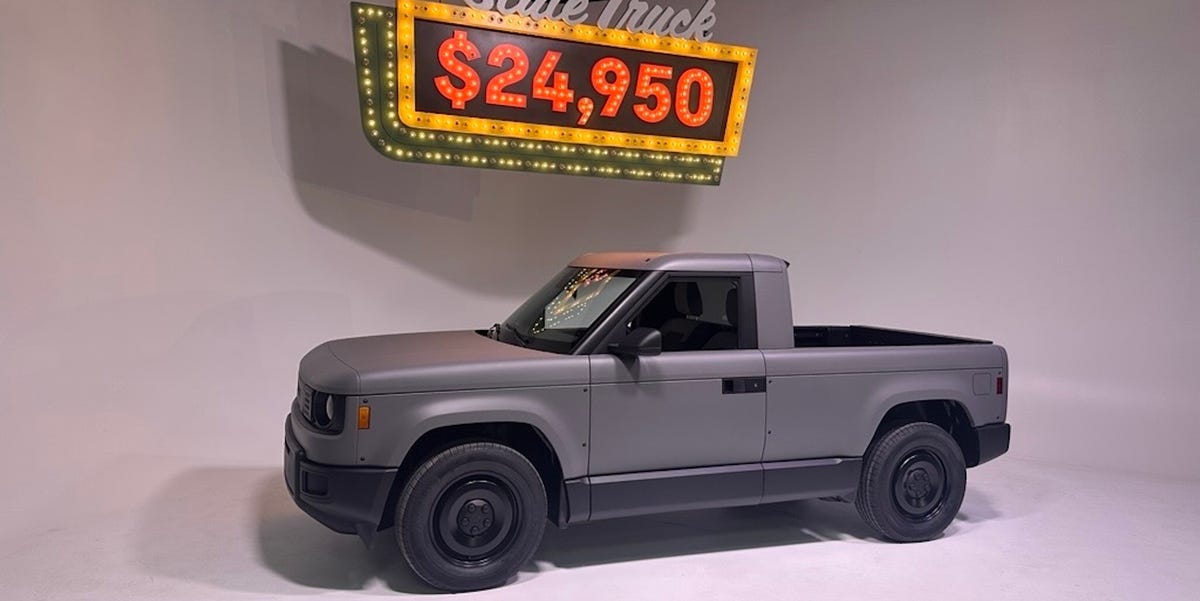
cross-posted from: https://piefed.social/c/electricvehicles/p/2162853/usa-slate-s-new-electric-truck-will-cost-slightly-more-than-24950
Range is said to be 205 mi (330 km), higher than the original estimate. This price is for the basic truck. The SUV configuration is expected to be $5000 more.
I don’t understand the obsession with range. I agree that efficiency is important, but who is regularly driving a pickup truck 200 miles in a day?
Rural people, as in the folks who actually have a use for pickups. As it so happens, it is about 200 miles round-trip to my nearest airport/major city, so if this were my vehicle, I’d have to take a charge break when picking someone up/dropping them off at the airport, or making a shopping run, or going to a concert/special event, or seeing a medical specialist. And I’m not even that far off the beaten path; I have family for whom the one-way drive to their nearest major city/airport is over 200mi. Plus if you’re hauling anything, I’d imagine that range goes down quick.
That 200mi estimate is based on driving around 30-40 mph
You can expect like 140 miles of range at highway speeds
I live in Wyoming so I understand rural, however we are not the only folks with a “real” use for trucks. Plenty of reasons for a townie to own one.
My point was more that a pickup’s core demographic live in places where range is absolutely a consideration. Some city folks do have good reason to own a pickup, but for most it’s an aesthetic/image thing. Which, given the environmental/traffic safety consequences of driving a larger vehicle than necessary, is plenty deserving of judgement imo.
The range is reduced when used to haul things around or when the AC/heat are used. With charging being significantly slower compared to filling up a gas vehicle and without the option to use a gas can if it runs out, there are unknowns and people don’t like unknowns.
I think the range is fine for regular light use personally, but being concerned about a fairly short range isn’t completely baseless. Or would be if the people buying it actually used it as a work truck.
It isn’t regularly, it is what you do on the margins. that one trip a year. Those really cold days in winter (ICEs have a built in heater). 200 miles is more than enough most days, but once a month it will be really close.
Only a fool purchases a vehicle for 100% of use cases. That’s how you end up buying twice as much car as you actually need, “just in case.”
A wise person figures out what vehicle will meet 95% of their needs and then simply rents a vehicle specifically designed to do that job. Do you need to haul a giant camper twice a year? Just a rent a pickup truck capable of towing it.
Buying a thing only saves money if the alternative is REGULARLY renting that thing.
It is likely impossible to rent a truck for pulling your trailer. Most contracts have a no towing clause. Uhaul only allows towing their trailers. When you find the rare exception you are risking they are sold out that week. And the cost when you do find it is high enough to pay for the additional payments for most of the year.
Ok, so if you only pull a trailer once or twice a year, why do you own a trailer? It’s back to the same problem. What’s the point of owning something you’re only going to use extremely rarely? Cars are ultimately depreciating assets. They’re not like owning stock in a company or even real estate. Every penny invested in a vehicle is ultimately money thrown on a bonfire. The wise way to own a car is to figure out your 95% of use cases and buy based on that. Then just rent specialized vehicles for the rare oddballs.
We have a newish Corolla and and old mid-2000s Ford Ranger. Between the two vehicles we have 99% of our use cases covered. We can move most furniture and shop and garden materials with the truck. We can use the sedan for commuting and road trips. But there are doubtless uses that our setup won’t cover, and that’s OK. If I need to move a household full of stuff, or if I desire to pull a giant trailer, or go offroading, then I’ll need to rent something else.
I own a trailer because even though I rarely need it, renting is too difficult. I did rent a trailer a couple times. However finding one that was available and fit my needs is harder than you would think. There are many different types of trailers, each serving a different purpose, and most won’t work for my purpose. When I need one is also the weekend others need one and so it is highly likely to be unavailable because someone else has it.
I’ve tried to make your “rent when you need it” for those rare uses. However every time I do I realize that the cost of a rental is very high, and most rentals have restrictions such that I can’t even use it for what I wanted. I’ve been lucky to never arrive to find my reserved vehicle isn’t there, but that has happened to many people I know as well (leaving them at an airport with no way to get around)
I collect antique tractors, this is one of those rare niches that make me unusual. Having to have a trailer for them to get to shows is part of the costs (and fun). To ensure I can do what I want when I want I have to own a truck and trailer.
While you are correct the cars are depreciating assets, so it life. I have more than enough money for the basics: I don’t need more appreciating assets. Most of my money is reserved for things that bring me happiness, and I don’t care (nor should I care!) if it is a good economic investment. Investing everything to grow a number on paper seems like a boring wasted life to me (but this is just me, if your happiness is that number then by all means invest more)
Ok you have a point. There are always some niche applications where the general rules fall short. I’m thinking of folks who own a giant truck to tow a giant camper once or twice a year. The number of people towing antique tractors is small, campers not so much. And yes, there’s definitely more to life than money.
Americans get anxiety from having to do math in their heads. Average commute distance is 30 miles a day, and there is always some asshole who whines about towing his boat.
But don’t try rational arguments with pickup drivers who commute to office jobs and drive a tank for that one time they needed to move a brother in law’s couch.
Miles are a bad way to track performance because real life conditions can wildly impact BEV efficiency. I can tell you from first hand experience that towing, elevation changes, or moving at highway speeds in winter can cut per kWh efficiency in half.
And beyond that, you’re supposed to be capping your daily charge limit below 100% for battery longevity. 200 theoretical miles can turn to 160 miles and down to 70 real quick. That can get uncomfortably tight if you miss an overnight charge.
Frankly, its dumb to criticize people who expect their personal vehicle to perform reasonably well in situations where a personal vehicle should excel. Why own a car if it can’t do a round-trip weekend excursion or haul a bit of furniture?
By your logic everyone should only need a tiny moped with a rain jacket and a backpack. It’s irrational to worry about climate control or passengers or suitcases, you statistically never need them.
You know what? You’ve led me to the diagnosis of my own EV range anxiety: Unpredictable performance.
In a gas powered car, you pretty much can think in miles. They put the “24 city, 29 highway” numbers on the sticker in the window, and that’s pretty close to what you’ll get out of it. Maybe loading it until it squats on the suspension or pulling a trailer or driving like a maniac will decrease the economy. But, if you do those kinds of things, you can fill the tank, note the mileage, drive like that awhile, fill the tank again, note the fuel consumed and the mileage performed and you’ve got a figure you can pretty much rely on no matter the weather. The limiting factor is almost always the driver. Drive 200-300 miles, stop for 5 minutes to fill the tank, drive 200-300 miles, stop for 5 minutes to fill the tank…
I happen to be a flight instructor. There’s a whole chapter in flight school about cross country flight planning and predicting aircraft performance. Wind is such a factor that you really can’t rate a plane in miles of range, but in hours of endurance. So to plan a flight, you look up the route of flight on an aeronautical chart, the weather forecast, read performance charts and tables out of the plane’s Pilot’s Operating Handbook, crunch a whole bunch of numbers and you’ll know fairly precisely how long you’ll be aloft and how much fuel you’ll burn.
With an EV…they spit out a range in miles that the vehicle will do in unspecified ideal conditions, tell you that heat, cold, using the heater, using the air conditioner, carrying weight, wind and age will reduce the range, and then they’ll get impatient with you if you try to work out what the vehicle will actually do and they’ll mail you anthrax if the answer you arrive at is “not enough.”
The plane trip is a great analogy. There’s probably plenty of data on which aircraft can fly it and, optimizations aside, you might have the option of over-fueling to be sure you can accomplish it.
With a BEV your pitiful energy limit might mean doing all those cross country calculations just to reach the other side of the state. And even then the sheer number of variables (Will I hit traffic? Will a fast charger spot be available at X? When exactly will it drop below freezing? Will my battery be conditioned at start? Does M miles of ~N mi/kWh surface streets beat M-Y miles of highway…) makes it impossible to precisely say.
You basically have to drive by feel, hence my reckoning of my car needing 1.5-2x dashboard mileage buffer for critical margin trips. I’ve personally made the exact same trip in different conditions and pulled in from as low as 3% up to 35% battery remaining.
The only solutions are way better/larger batteries, much smaller cars, or massively expanded charging infrastructure. Unfortunately nothing [affordable] in the market is addressing any of those.
I think the market is addressing all three. The F-150 Lightning is giving way to the Slate and Ford’s upcoming Ranchero. They’re working on battery chemistries, they’ve been getting better. Charging infrastructure HAS been built out.
Gas car owners haven’t seen EV charging stations going in, because they’re often put in out-of-the-way places. They’re not as visually obvious as gas stations, so gas car owners may have been surrounded by them and not realize it. So they don’t feel like the infrastructure is there, when it is. The EV charging industry has done a better job of concealing itself from the American public than the NSA.
I could rant about charging stations being difficult to find, “But use an app” you mean nazi stalker software? We’re in an age where a lot of people want to step back from all that shit because of who’s running it all. I genuinely do prefer to find gas stations by seeing their signs. I could throw my phone in a lake and drive my 2005 Buick to California, right now. I know how the US interstate system works and I know how to find and buy gas without any precise location enabled spyware.
Let’s ignore that for now, and instead: EV prononents like to point out that most charging will be done at home, and charging away from home will be a rare occasion mostly on road trips. Lemme ask you something: You got an app on your phone you only use occasionally? It’s a pain in the ass, right? Go to order your quarterly pizza from Domino’s and the app needs to be manually updated and logged back into and their terms of service have changed…sounds like fun to deal with when you’ve been sent on a 4 hour mission and you need to find a charging station. Phone apps aren’t tools you can get and put in your toolbox until you need them, they rust.
BUT ANYWAY. What they need is better communication of the vehicle’s limitations. The manufacturer spits out a number achieved in ideal conditions. Then you talk to owners and they go “Yeah. WELLLL…it depends” and start listing the conditions where you won’t get that. Start telling me what the machine WILL do, give me ways to predict the vehicle’s performance in non-ideal conditions, or start engineering those limits out.
I’d rather hear “It will do 200 miles between charges.” more than “It’ll do 300 miles. WELLLL…it depends. Maybe it’ll only do 180 if it’s cold out and you’re running the heater.”
The overall point I’m getting here is that yes, that’s a fine expectation to have. But do you really need a King Ranch Super Duty just to go to the airport twice a year?
Sure they do, but then complain about aFFoRdAbIlIty when a tank is $250.
Thats the trouble with private vehicles in a nutshell. Sit idle for 95% of the time, and we need to buy models that are capable for the 1% of the drives we might want to do in a year.
Maybe if you don’t know how to rent a car…
That’s a false dichotomy.
I’ve been driving an S10 for decades. Yeah, it’s a little bit 20th century, it makes 18mpg out of a large, slow, primitive V6. It’s great for small truck missions, it’s reasonable for long hauls, and I can expect to go THIS far on THIS much gas.
Not far on a lot of gas.
My obsession isn’t with range, it’s with charge time. Yes I’m a bit irrational wanting a fully charged car every morning but that may not happen with a lower battery efficiency using a level 1 charger. I’m sure you’d appreciate better range efficiency like any gas car user would want better MPG.
Even with high efficiencies, you are going to have troubles with a level 1 charger. Level 2 charging is 5 times faster and still takes a long time to fill a battery. The most efficient consumer EV, the Kona, only charges at 6 miles per hour of level 1 charging. Yeah, you can get 80 miles of charge leaving your car charging overnight, but it completely limits any flexibility in using your car outside of commuting. I should know, I tried to do level 1 charging with a 90 mile range car for a couple months. It sucked, so I got a level 2 charger installed. After that, the 90mi range was fine for 3 years.
The shorter your range the more important fast charge is. My car with a 200 mile range is almost(!) always fine on level 1 since I so rarely use make so many trips in a row that it would empty the battery. My wife’s phev with only 30 miles of range is always at near 0% when she gets home and she (like most people) is likley to be making another trip soon so level 2 is a must. (of course it could switch to gas it isn’t charged, but gas is several times more expensive so we try to use gas for long trips only)
Yeah, 120v15a is a pain. At least see about rewiring an outlet for 220v 15a. An electrician can often do it cheaply because its the same wires. Then you can get most of a full charge between commutes.
In almost all cases your 120V15A outlet has other outlets on the circuit and so it cannot be rewired that cheap. In almost all cases it is really 120V 20A though, so you can set your level 1 charger to a slightly faster rate since odds are nothing else is running on that circuit (but good luck finding a charger that supports that faster level 1 rate).
More range not only means driving further without charging but also fewer charge cycles being needed.
Imagine it being like your phone when you play games and the battery dies after 6 hours. How long do you think your phone’s battery is going to last when you’re regularly charging it that often? Now imagine you paid $30k-$100k for the phone and you’ll see why range is important to most people.
I personally have a 100 mile work commute and have decided not to get an EV for the time being because I want one I can keep at least a decade like my current ICE (Camry) without worrying about a $20k battery replacement or having to constantly keep it on a charger. It looks like the new solid state batteries should solve this issue but nobody is producing them yet.
My only problem with the Slate’s range is that, being a truck/SUV, I would want to use it for overlanding (the kind of use-case where even gasoline vehicles need extra fuel tanks strapped to them, as shown here). Trying to do that with an EV with anything less than exceptional range would be limited and take careful route-planning.
Obviously it’s not a “regular” use and therefore shouldn’t rationally be a deal-breaker, but nevertheless taking a couple of jerry cans is a lot less weird and complicated than towing a generator. (And the fact that I’m seriously considering the latter as an option just goes to show how much I like the Slate truck anyway.)