

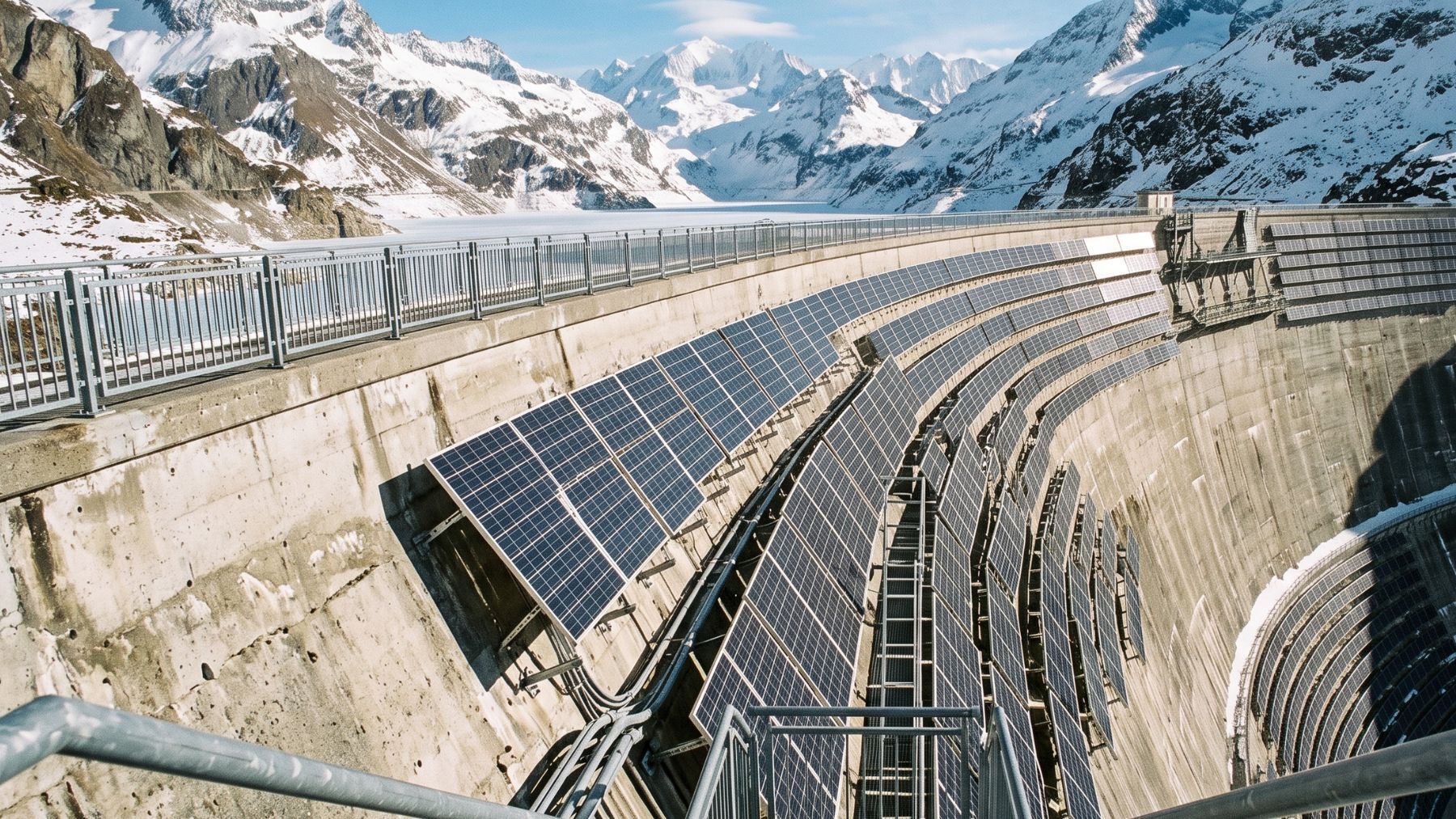
Up on the dam, almost everything that looks like a problem becomes an advantage.
The plant sits above the fog line, in thin, clear air that lets far more sunlight through.
The higher you go, the stronger and cleaner the sunlight becomes.
Cold actually helps, because solar panels work more efficiently when they are not baking in heat.
And then there is the snow, which acts like a giant mirror, bouncing extra light up onto the panels from below.
Scientists call it the albedo effect, and it can lift a mountain plant’s output well beyond anything possible in the valley.
A test site at a similar height recorded yearly output far above a typical Swiss plant.
I would imagine that you could set up some sort of insulated battery and/or capacitor setup that could be used to melt off any accumulated snow and ice once a storm passes with some heating elements embedded in the photovoltaics. Though, that probably introduces the issue of falling frozen debris striking panels lower down on the dam. Nonetheless, given the efficiency gains, it’s probably a problem worth solving - especially since this Swiss proof-of-concept seems to be working out so well.
photovoltaic panels are just giant diodes you can run them in reverse and every panel gets that 0.6V voltage drop like any other silicon junction