

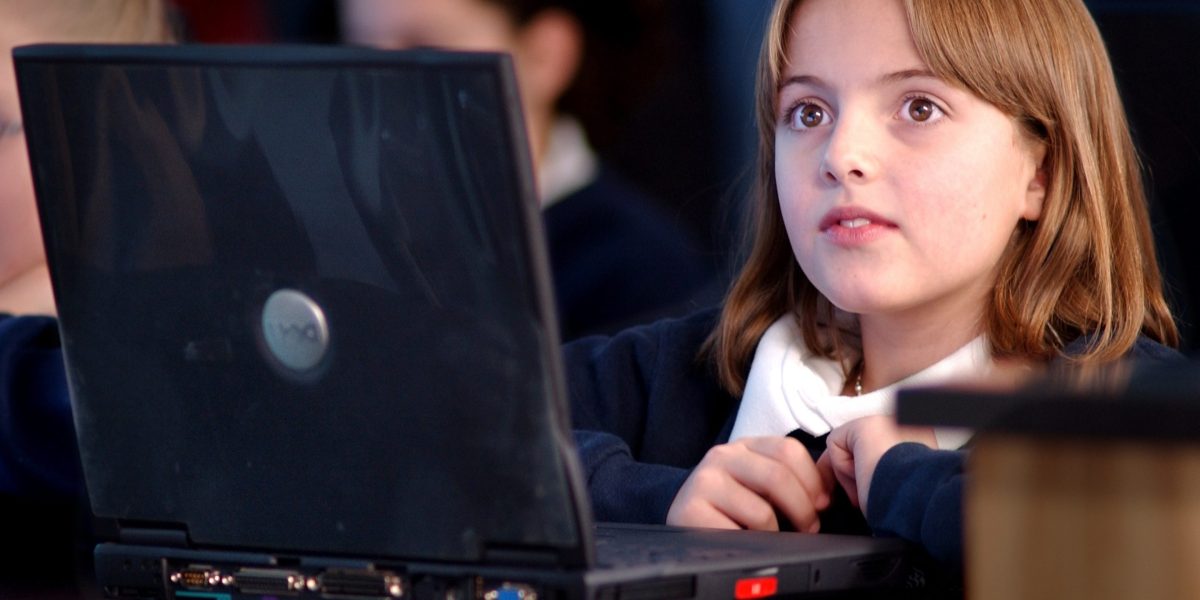
In 2002, Maine became the first state to implement a statewide laptop program to some grade levels. Then-governor Angus King saw the program as a way to put the internet at the fingertips of more children, who would be able to immerse themselves in information.
By that fall, the Maine Learning Technology Initiative had distributed 17,000 Apple laptops to seventh graders across 243 middle schools. By 2016, those numbers had multiplied to 66,000 laptops and tablets distributed to Maine students.
King’s initial efforts have been mirrored across the country. In 2024, the U.S. spent more than $30 billion putting laptops and tablets in schools. But more than a quarter-century and numerous evolving models of technology later, psychologists and learning experts see a different outcome than the one King intended. Rather than empowering the generation with access to more knowledge, the technology had the opposite effect.
Mostly posting this because holy shit what a jump to blame schools distributing laptops being the cause and not psychologically addictive social media algorithms having a total domination of their attention
Definitely nothing to do with the fact that schools giving out laptops disproportionately benefits less wealthier families
Giving kids laptops was a great idea. Letting corporations use those laptops to brainwash our children was probably not.
“Educational” software is terrible.
It educates kids to use MS Office and ChatGPT.
Many got chromebooks and just had google everything.
Someone clearly hasn’t played Typing of the Dead.
You shut your whore mouth about Oregon Trail
It was a different time.
The issue was not being willing or able to curate their online experiences when given computers.
Nah, it’s a bad idea, especially with internet connection. They are portals of distraction.
My schools just had a computer lab, and we still mostly figured out how to play games or hack the computers.
I remember one time, on very locked down PCs, I figured out how to use DirectX diagnostic tools to start a group chat on the local network. I didn’t even know about that thing, nor was there internet.
I can imagine computers being good only as fully controlled environments with secured connections, no USBs, total control over what software can be opened and used. Anything less is a waste of time.
“These things that I was given access to during my formative years and education? Yea, we absolutely shouldn’t let kids today have any access to them at all… for reasons(?)”
Anything can be a portal to distraction for kids that are bored to tears by an awful teacher, better not let them have colored pencils, they might ‘waste time’ drawing. If they don’t interact with computers at all for their education, they will definitely only think about computers as a box for games and/or youtube, and they will struggle with their use for a long time after. We need an environment to explore the systems and the world around us, where there can be boundaries if we get too far out in left field before we are dropped into the real world with real consequences.
I had one at home. The lab was fairly useless and definitely not good for exploration. I learned from breaking and reinstalling the OS and other things; if you do that at school, you get in trouble.
It would have been a longer and more complex article requiring a lot of research if they tried to go through all the issues that could be contributing. Hell, it’d be a book.
multiple books, each discussing a different issue.
Correct, and an actual study can isolate variables and when you do that, tech is usually a boon. It’s especially easy to do with tech, but long term studies are still difficult because of history effects and imperfect control groups.
I can believe Gen Z is doing worse, but almost every study I’ve been around in education has found Socioeconomic Status to be the strongest factor (by far) and given Gen Z and Alpha are raised by the first generations to have economic decline, it stands to reason that’s probably the main factor here.
School interventions do help to some degree to mitigate SES, it’s just hard when it’s this bad for this long. We’re talking decades of decline.
That is brought up near the end of the article.
It doesn’t have to be. Rote memorization always is for me, but that’s not really learning. And you can focus on just about anything when the alternative is a shitty textbook poorly explaining something that just won’t click with you. Look out the window, doodle, count the ceiling tiles, daydream about not being stuck in school, …
The burden of proof is on you for your claim.
Why does learning not need to be effortful or not difficult or not oftentimes uncomfortable?
Yeah, I have literally never gotten better at anything without effort, difficulty, and sometimes being uncomfortable. These things are ingrained to mastering any skill.
I think if it as no difference than lifting weights.
Do hard things till they get easy, then do harder things.
Your average person should probably not walk into the gym and start by trying to lift the heaviest weight they can. Many people stay active and healthy by doing something much easier, like walking or jogging with minimal or no weight.
Something that we learn to do as children almost instinctively…
Something… Easy.
From the context the combination of these three words sounded to me like they are demanding kids sit still and focus for hours, and that if they fail then that’s a lack of effort, determination or intelligence. You can work through a problem slowly and deliberately because it’s hard to understand, that can feel very rewarding even if it’s hard. But you can also be forced to mentally strain yourself for hours, not because of the subject itself is difficult but because the environment, the provided material, the pressure, … make learning in and of itself take a lot more effort than it needs to.
Be careful not to conflate effortful with boring. Learning can be fun but fun doesn’t mean easy or lacking in effort. Fun just makes it easier to remain motivated.
Learning can take effort and be fun, that’s true. Same goes for difficult. But if you put those two in with uncomfortable then I hear that it’s meant to be painful, essentially. Goddamn kids need to sit still and learn, and they can not do anything else for hours, or else!
Give the kids a blank laptop that they must erase weekly, and a thumb drive with the basic Gentoo installer.
I know you’re joking, but what would result if this actually happened would be after 1 week 99% of the laptops would never be powered on again and simply be handed back in at the end of the term.
I’d be more worried about the 1% that are still being used. You’ve created a group of kids that know more about the computers than most IT departments.
Those aren’t kids to worry about. Those are kids to put into advanced classes because they’ve got some great understanding of complex topics and problem solving skills.
Never underestimate ingenuity. Although the lazy kids would ask the smart kids for shortcuts. Most likely.
Well that’ll definitely make them resilient in the face of adversity, at the very least.
THANK YOU. As a teacher, this guy made me rage hard. And even harder when older teachers who already hate technology latched on to it as an excuse. Show me evidence for fucks sake when middle school teachers are ALSO now teaching multiple subject areas, have way less prep time, the school has less money, are also responsible for live online grading and access to assignments.
Also, I love fediverse. Rational mind heaven
I’m glad I’m out of middle and high school, both were hell for my ability to learn due to teachers like this. I’ve tried and tested the fact that I objectively learn better on computers than books and writing, but the many teachers who would outright ban laptops in their classes because “you can’t learn on those, you all get distracted” would cripple my ability to learn. Writing is difficult for me as well, and I’ve always had horrible and slow hand writing, but I have abnormally fast typing speed and can type notes while listening fully to the teacher, which is why I breezed through my more tech focused classes for instance.
Of course, I don’t blame those technologically conservative teachers for their views, since monetary interests have crippled the medium enough to make digital education difficult for the vast majority of people, but that doesn’t mean some aren’t the opposite and learn quicker and of higher quality on digital mediums rather than the standard analog mediums.
Then it’ll make the wealthy stupider.
I would be willing to bet that is the case, but good luck doing a study to test the hypothesis.
the wealthy know this, they are shielding them from it, placing them in montiserri type schools, aka rich people tutoring, learning grind+ make sure they are in sports, get all extracarricular. with a poorer family its an IPAD/TV/computer doomscrolling , or watching youtube, streamers.
https://fortune.com/2026/02/21/peter-thiel-bill-gates-steve-jobs-steve-chen-tech-billionaires-publicly-shielding-their-children-from-tech-products-social-media/
I also think schools are not evolving to the reality. There’s little incentive to memorize facts in a world where they are so easily acceptable. So we shouldn’t teach the memorization of facts.
We should teach people how to use information, how to criticize it, how to synthesize it, how to apply it. If these pursuits are taken seriously students will retain the information.
This issue is that’s much more difficult to test for than the memorization of facts.
I teach immigrants the local language, and students are never grateful to be taught a language. Students are grateful when you teach them how to learn a language.
That might seem like a distinction without a difference, but it’s not. There are thousands of words that people use in common conversation, tens of thousands that you can find in standard newspapers and normal literature, and even more if you want to read academic or specialized literature. When I teach the meaning of one word, that’s giving the students a fish. When I teach them how to break down prefixes or give them advice for increasing their exposure to language input, that’s teaching them how to fish.
The problem is that it only works for students who care. That’s fine by me, because I teach adults and they can decide whether they want to learn or not.
I don’t know how k-12 teachers navigate that, because it’s not exactly the student’s choice- we’ve decided as a society that kids need to learn certain things, whether they want to or not (basically), and that means that schoolteachers need to be able to teach students who don’t care or actively want not to learn (at least about a given subject). Just teaching them to teach themselves doesn’t work there, so you have to teach them some facts, because otherwise they won’t learn any.
It sucks, but I don’t know if it can be fixed. It’s reasonable that students don’t care about every subject, and it’s reasonable that there are things we’ve decided they need to learn, regardless of their interest. Teachers can’t always make a subject interesting to everyone, so sometimes you have to teach the base facts.
I relate to this immensely. I’m taking german classes currently and the professor is driving me insane.
She uses an immersion only method where she speaks German at us and we do exercises from a book.
I am slowly getting an understanding of the past imperfect and various grammatical rules but only barely. There has been no real instruction on how these rules work so when I encounter a new verb or noun it’s a total guess everytime.
From my understanding speaking with some Germans, this is the preffered method for teaching English to school children. Which I must admit does seem to work well the English proficiency of the average person is quite high, even amongst those too afraid to speak it their comprehension is high.
The issue is I do not want to be learning German for the next 8 years as a German student would learn English in school. Also my brain is fundamentally different than a child’s. If they were to explain the rules and grammatical concepts it would be much much easier to understand.
A blended approach where the rules for new grammatical concepts are first explained followed with the immersion based exercises we’ve been doing would be ideal.
Yeah, I’m sorry about that. I actually teach German, and especially for students who have a good language sense for English (so if “I singed a song” immediately sticks out to you), tenses are mostly (with some obvious exceptions, like present progressive and preterite/perfect) pretty similar.
She’s probably trying to get your brain to recognize an irregular verb so you don’t have to learn each verb anew, but that’s a problem you’re less likely to have as an English speaker (for example, you’d say “Morgen singe ich, gestern sang ich, heute habe ich noch nicht gesungen,” which is pretty intuitive after English).
Fwiw, you do retain it longer if she sets it up so you can draw your own conclusions, but you also learn more slowly. And if you’re highly motivated, you’ll probably remember it well enough either way.
The whole class speaks English at a B2 level since that’s what is required for International students at the university. I do feel like that could be capitalized on given the similarities.
Honestly I truly feel like I paid someone to read the Kurs DaF A1 book to me. Rarely there are other exercises or explanations.
Comparing other language course I’ve had I liked my high school French teacher’s approach. She primed us with explanations of the new concepts and grammatical rules. Then she followed up with immersion and exercises.
My Spanish courses in college and high school were just memorization based. I technically reached a higher level of course in Spanish, but remember next to nothing. My comprehension of French is much better.
Truthfully I need to dedicate more time to my German, but my other studies being all English take up my time. I’m here for a master’s degree. The language is an additional skill I would like.
And if you care for learner’s perspectives, give quizzes. I don’t know how to explain it, but when we took our first test I felt a lot of concepts click into place because I had to perform if that makes sense. It’s like my brain felt the pressure and acted. It made me wish we had regular quizzes on the content in between tests.
That’s rough. I’m currently teaching at a school where they basically hired me to do that, but they’re not upset that I’m not. The teachers at the school are mainly university students in language related fields, but they mostly don’t have any experience or training in didactics (my autocorrect twigged on that-is it still pedagogy when you’re teaching adults?), so that’s an okay way to get people doing an alright job.
I’m almost done with my masters thesis in German instruction, so I’m not an expert teacher or anything, but I know how to construct an assignment and what didactic principles should guide a lesson plan. And just teaching to the book makes me feel pointless/like I’m cheating.
If you want a pretty good guide to grammar based on comparison with English, then try English Grammar for Students of German
That’s very good advice, thank you. One of my students currently is in his mid 50s and he’s got a lot of experience learning things (not just his age, he’s had a lot of huge life changes that required him to do totally new things), and it’s so incredibly helpful. I gave them a quiz when I started teaching them (their last teacher went on leave partway through) and everyone (good naturedly) groaned a little, but he was 100% down for it and got the class to settle.
It helped show me their gaps, and I was able to anonymize them and have them peer correct, which was even more helpful
Just relying on classes is slow no matter what method they use. You need to study at home as well and something different from what you learn in class so don’t use the textbook from class. I think the best way to learn a language is to focus on vocabulary first. Like learn the 2000 most frequently used words first through rote memorization. Then grammer comes more naturally since you can get a lot of things from context. Also native speakers don’t know the grammar rules by heart, to them forming a correct sentence just comes naturally. Sure it’s good to know the grammar rules and concepts, but to make it come naturally requires a ton of reading and listening and eventually speaking and writing and that requires a large vocabulary.
The most used method for vocabulary is flash cards. Many people use a program called Anki and a German flash card deck has already been made by the community.
https://ankiweb.net/shared/info/9489615
My seventh grade English teacher got permission from admin (she told us this) to spend her whole semester with us teaching vocabulary. Word roots, prefixes, suffixes, etc. That was helpful, and interesting, and the first time I enjoyed learning English. I still struggled in English, but I did better after that.
I couldn’t disagree more. We should not be teaching kids to rely their phones. This is literally the same attitude the article talks about.
Rote memorization sucks but it’s 100% a necessary skill if you’re going to learn literally anything. Do you really want an electrician who lives on his phone because he didn’t memorize important aspects of his job? How about a surgeon or a lawyer?
There’s no getting around the fact that you need to memorize things if you’re doing to develop a deep level of skill in any given field. Your phone or laptop is not always going to be there.
I was homeschooled. My mom was always avidly against what she called “read and regurgitate.” Instead she supported “teach how to learn.”
It was a different world back then, but the lessons still serve me well.
it’s like blaming the obesity epidemic on plates…
You actually can influence how full a person feels after a set amount of food based on how big or small the plate is on which the food was served.
The addictive qualities of ultra processed foods at the same time as the diminishing nutrition of processed and unprocessed foods alike is obviously so much more of a contributing factor, but isn’t it nuts that plates can also have a measurable effect?
when it’s microplastics!
Right, like I’ve seen parents shove a tablet or a phone in their toddlers hands before they learn how to walk properly, and they keep scrolling mind numbing short form slop on it, and they want to talk about school laptops lol